

Debbie Qaqish is Principal Partner and Chief Revenue Marketing Officer for demand generation agency, The Pedowitz Group. A nationally recognized thought leader and innovator in revenue generation, Qaqish has over 30 years of experience helping organizations connect marketing to revenue. She is a pioneer in marketing automation—first as a beneficiary of the technology and now as an advocate and expert. Her first book, "The Rise of the Revenue Marketer®," will be published in 2012.
 Who is teaching the CMO how to sell? If you’re in sales, you might think this is an odd question or you might have a stronger, more visceral reaction to the question—“Marketing doesn’t sell, we do!”
However, if you’re leading a marketing organization in a B2B company, this question is directly tied to marketing’s new revenue imperative and it can be a very scary question. The line between sales and marketing is becoming more blurred every day. What was once the bastion of sales—the sales funnel from top to bottom—is now shared with marketing. How the B2B organization “sells” is being re-written as we speak and the newest key player in this scenario is marketing. DemandGen Report recently called this “a shared revenue funnel” and in a recent Revenue Marketer Radio interview, Yvonne Anderson at NCM called it “the revenue team.”
Further, in companies in which marketing fully participates in the revenue cycle we see improved closed rates, lower cost of sale, and improved revenue results versus the competition. Who doesn’t want this?
Let’s see what is causing this role re-alignment and how the CMO is learning these new skills, specifically sales.
The drivers for a shared revenue funnel and the revenue team comprised of both sales and marketing are:
- Buyer behavior has changed. Buyers can now glean a majority of information on potential solutions from the web or through social media. This disintermediation with sales has effectively given control of the sales cycle to the buyer.
- But all is not lost. While the buyer is now going online and choosing not to speak to sales early in the buy cycle, tools like marketing automation allow marketers to see this online behavior and respond to it so that marketing can now create an intimate, digital relationship with the buyer. Marketing now owns the top of the traditional sales funnel.
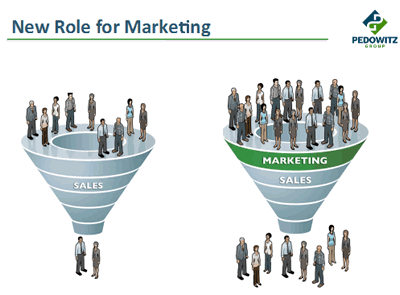
- Finally, the past few years have been tough on many industries and when revenue slows down, it is typical for companies to explore new and better ways to drive revenue. Between new technologies, new buyer behavior and an open mind for new ways to drive revenue, the role of marketing in revenue production and the resulting required “sales knowledge” for the CMO has lead us to this question—“Who is teaching the CMO how to sell, or who is teaching the CMO their new role in helping to drive revenue?”
The short answer is they seem to be learning this “on-the-job” and this can be quite a challenge especially in the enterprise organization. The typical CMO in a larger enterprise has been in marketing most, if not all, of their professional career. They cut their teeth on product-price-placement-promotion—the 4 Ps of marketing. To all of a sudden be responsible for “sales” or “driving revenue” in a direct contribution model can be daunting. So let’s look at where the CMO might learn these new skills.
Academia: If you look at undergraduate and graduate programs in marketing across the US, you’ll see an obsessive focus on B2C marketing as if this new way of marketing for the B2B organization doesn’t even exist. Even when they try to address B2B and the tools and processes required, it’s a 30-minute lecture or 2 paragraphs in a text book (which I recently saw and they had most of it wrong).
Industry: The vendors in the marketing automation space provide training and education, but it is very focused on how to use the systems they sell. This education centers around tactics such as is lead scoring, creating email campaigns, building landing pages and tracking new metrics. They are assuming that the CMO is already on board and knows how to lead a revenue marketing team.
Corporate: When is the last time you saw marketing, especially the head of marketing, participate in sales training? We are beginning to see more and more of this, but it is the exception, not the rule.
Professional: Groups such as AMA, MarketingProfs, MarketingSherpa, OMS and others began with a tactical focus and are just now offering broader topics for the executive. I recently did a webinar for AMA called The Rise of the Revenue Marketer which begins to address the role of the marketing executive in revenue. However, this is still short of really providing the training and education required to ready the marketing executive for this new role.
The role of marketing in driving revenue is here and it is not going away. New buyer behavior, new ways to digitally interact and a keen quest for revenue ensure this role stays in place and may even expand. We call this role Revenue Marketing and advocate for this becoming a distinct role in the marketing world—just like product marketing or marcom.
So how can today’s CMO gain these new skills? Here are 3 ways to get started:
- Fully understand how your organization sells. Go on sales calls, listen in on sales calls, attend all sales meetings, get a copy of the documented sales process. Invest time and energy in understanding how the sales teams close business. Do not hand this off to one of your direct reports—do it yourself.
- Investigate the role marketing plays in driving revenue using marketing automation technology—this is THE game changer. For CMOs not looking at how to leverage this kind of technology in a B2B environment, you probably will not be keeping your job for long.
- Map out the Life of a Lead process from cold lead to close. With marketing automation, you will be able to succinctly define your role in helping to drive revenue. You’ll want to do this process WITH sales. This map becomes the foundation for building effective revenue marketing programs.
In addition to these three options, I believe we’ll begin seeing more executive level training and education to fully prepare the marketing executive for their revenue responsibility.
Topics: B2B Marketing, B2B Sales, Inbound Marketing, Increase Sales